Posts

Showing posts with the label traditional

Meditation (Dhyana) - An extreme level of Yoga

Image
Buddha doing Meditation (Dhyana) Meditation (Dhyana) - An extreme level of Yoga After having successfully mastered all the preparatory cleansing, 'asanas' and 'pranayama'; one is ready for 'proper meditation'. The 'Hatha Yoga Pradipika' text dedicates almost a third of its verses to meditation. Similarly, other major texts of Hatha yoga such as 'Shiva Samhita' and 'Gheranda Samhita' also discuss meditation.  The ultimate goal of meditation is attaining liberation('moksha'). This is achieved, through the awakening of 'Kundalini' (or seven-chakras of divine energy) that are present in the human body. 'Kundalini', is a form of divine energy (or 'shakti') supposedly located at the base of the spine ('Muladhara'). The term along with practices associated with it was adopted into Hatha yoga in the 11th century and other forms of Hinduism, as well as modern spirituality and new age...

Pranayama - Ancient breathing techniques in Yoga

Image
Pranayama - Ancient breathing techniques in Yoga Yogi Kamal Ji doing Pranayama & Meditation at Mouni Baba Cave on the way to Neelkanth (Lord Shiva) Temple  Hatha yoga is much more. It extends well beyond being a sophisticated physical exercise system and integrates ideas of ethics, diet, cleansing, pranayama (breathing exercises), meditation and a system for the spiritual development of the yogi. Proper diet: The Hatha yoga texts place major emphasis on 'mitahara', which connotes "measured diet" or "moderate eating". Several Hatha Yoga texts like 'Hatha Yoga Pradipika', 'Gheranda Samhita' and 'Shiva Samhita' includes 'mitahara' as an essential part of a Hatha yoga holistic practice. According to Hatha Yoga Pradipika, verse 1.57, "A Brahmachari, practicing 'mitahara' (moderate diet) and 'tyaga' (renunciation, solitude), devoted to yoga achieves success in his inquiry and effort within half a ...

Hatha Yoga - Traditional style of Yoga Asana

Image
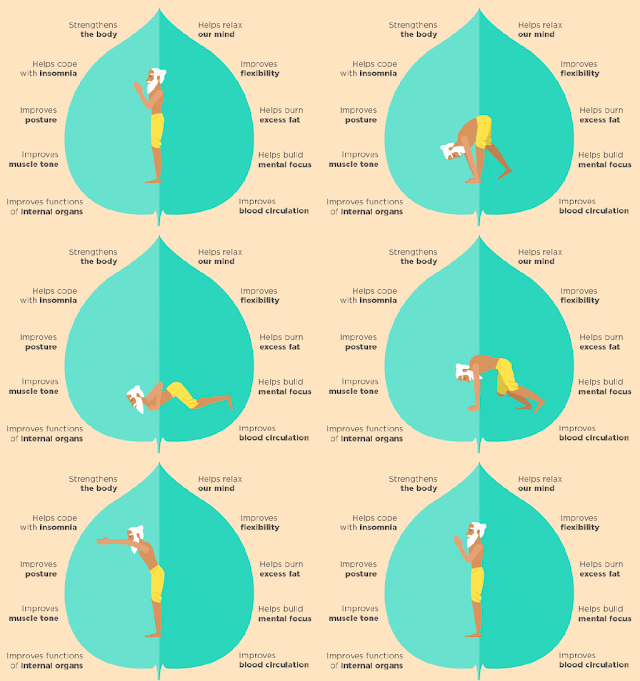
Hatha Yoga - Traditional form of Yoga Surya Namaskar 'Hatha' in Sanskrit means 'force/persistence' and thus alludes to a system of persistent physical techniques(or mental techniques) Hatha Yoga is said to be popularized by Yogi Matsyendranath, who also laid the foundation of 'Natha Sampradaya'(Natha Sect). Matsyendranatha, also known as 'Macchindranath' or 'Minanath' is said to be born around the 10th century CE around Bengal(although there are diverse opinions about his place of birth). He is revered in both, Hinduism and Buddhism and is sometimes regarded as an incarnation of 'Avalokiteswara' (a Bodhisattva) in Buddhism. There are many legends about Matsyendranath; most popular being the one which says, "Matsyendranath was born under inauspicious stars. This warranted his parents to throw the baby into the ocean. It was there that the baby was swallowed by a fish. The fish swam to the bottom of the ocean where Shiva wa...